My
Way of
Tying
the North Country Flies.
I have had the privilege the last years to be able to tie North Country Flies using
the right materials. I had myself a few blind trout-hooks left from my very
early acquaintance with John Veniard and later good friends have provided me
with others and a special gift has been some of the very old blind hooks from
firms in Redditch and Kendal like Adlington & Hutchinson, Hutchinson &
Son, Bartleet & Sons etc.
I turn the gut twice around the point of my left index-finger and finish turning the end around the two loops to ‘secure’ them so that the gut shall not ‘take too much place’ during the tying.. The long end that shall be tied down to the hook I give a few bites between my front teeth to make small indents to give a better hold after tying down.
From many sources I have got a supply of the needed feathers and furs. Also from Veniard I got many years ago colour powder to dye Hare’s fur in the real Crawshaw’s Red Spinner color for Edmonds & Lee’s March Brown.
My supply of Water Rat-fur is very old and I caught the rat myself: One day I as usual saw a Water Rat swim over the stream in front of me and ‘the devil took me’ - I send my wet-fly out over the rat and hooked it and after much trouble I got it to shore and could kill it and later skin it.
When
I shall tie one of the flies, I first prepare the needed feathers, furs and
gut. I remove the sharp edge on the underside of the front of the hook, so it
shall not be a risk for the gut.
As an example I have chosen Edmonds & Lee’s No. 8b - March Brown:
|
Hook |
2 or 3 (12 - 13). |
|
Body |
Orange silk, No. 6a, dubbed with the fur from the nape of a Rabbit’s neck which has been lightly tinged with Crawshaw’s Red Spinner dye, and ribbed with gold wire or tinsel. |
|
Tail |
Two strands from a feather from a Snipe’s rump, same feather as is used for the wings. |
|
Head |
Orange silk. |
My first procedure is with a Tirolite-stone to round the front-edges of the shank of the blind hook.
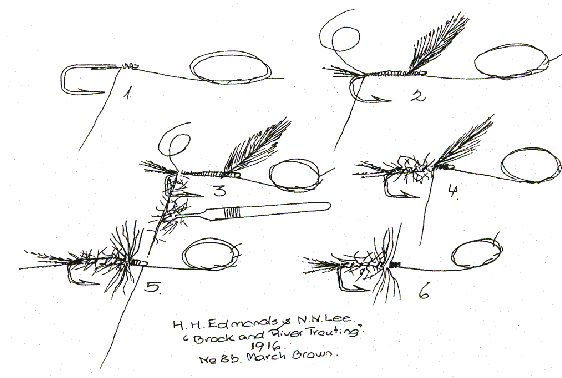
I
start the tying 1 mm behind the end of the hook and after three turns backward
and the same turns forward and backward again - to make a knob -
I tie the gut down on the underside of the hook. (*) After two more turns I tie
the feather for the hackle down on top of the hook and turn the thread to the
bend with very firm turns, where if needed the tails and rib are tied down.
(*)
By this procedure I prevent the gut to come into contact with
the iron and by this be damaged. I learned this procedure a few years ago by a
spanish prof. flydresser and now I have seen it mentioned many years before in
Geo C. Bainbridge book "The Fly Fisher's Guide". 2nd edn. 1828, page 103.
The
last years I have used a dubbing method I saw on one of Gary LaFontaine’s
videos: The thread is touched with a very tacky wax (Yellow Norwegian ski-wax
is excellent). I take a small amount on a needle and place a tiny coat with no
‘lumps’ along the part of the thread that shall be dubbed. Then I take a
small amount of short-fibre wool with a pair of tweezers and then touch the thread with
it. Attention! No contact between the tweezers and thread! In this way one can get a very
fine, sparse dubbing, where the colour of the tying thread can be seen
through, as said in the old patterns. This I wind up over the shank and - if so followed by the rib - and both finished short of the feather. One has
to be very careful, when the hackle shall be wound, then most of the used
feathers are very fragile. Two or at most three turns are wound to the rear
and tied down.
The old recipes states that one shall finish the tying behind the wound hackle, so that the fibres will stand erect out from the hook - but I place a few turns of the thread close up behind the wound hackle, which I press forward with my fingers before the turns are placed and then I secure the hackle with wide turns of the thread through it and then make some turns close up in front of the hackle.
Then I place the finishing knots on the stump of hook in front of the gut and by this press the gut a little away from the dangerous steel!
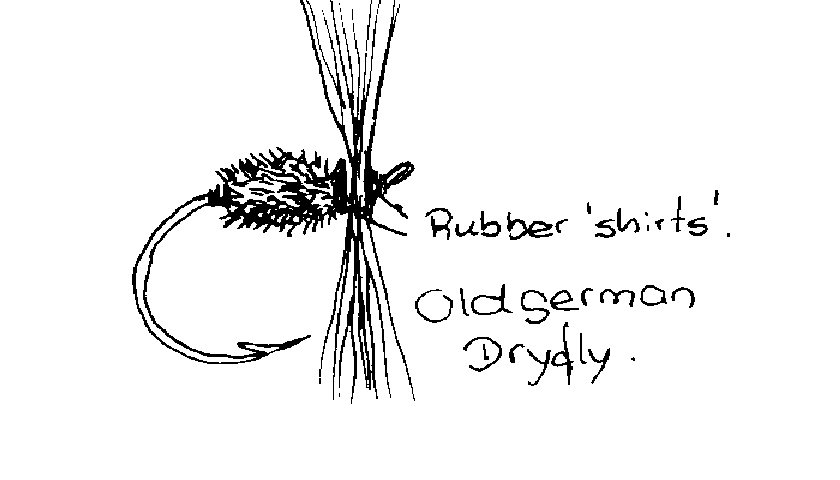
I learned this method of tying the gut to the hook when I visited Spain in 1980 for the annual flyfishing competition around Leon. Even today the spanish flyfishers use blind hooks tied to gut or nylon.
Two other flies:
The Plover Dun.
Hook #13
- 17
Tying thread Copper-coloured.
Hackle Yellow-freckled feather from the marginal coverts of a Golden Plover.
Body The tying thread very lightly dubbed with blue Water Rat fur.
Torp’s North Country Fly.
Hook #14
Tying thread Georgio Benecchi - light olive.
Hackle Grey Partridge dyed in picric acid.
Body Orange-red Lure Flash twisted around the tying thread - waxed with very tacky
wax ,
and dubbed
with a blend of Yellow SLF and Poul Jorgensen Highlander SLF in equal parts.
|
|