Thoughts concerning Flies and Fly Fishing
'FLYFISHING'.
Many years ago I had an experience fishing my favorite stream - Binderup creek. After having ended a days fishing I found that at the upper end of our stretch trout - surely rainbows, then it was just near the outlet from a trout farm - were rising steadily. As a challenge I first presented an ordinary, high-floating dry fly - but they rejected every presentation. Then I changed to a fly that only floated in the surface, not upon it, and they took it. It was the favorite of the situation.
Many fishermen has had the same experience;
but few has drawn the conclusion: On many occasions we have to present our flies
so they lay in the surface-film. It's an old knowledge, when we talk about
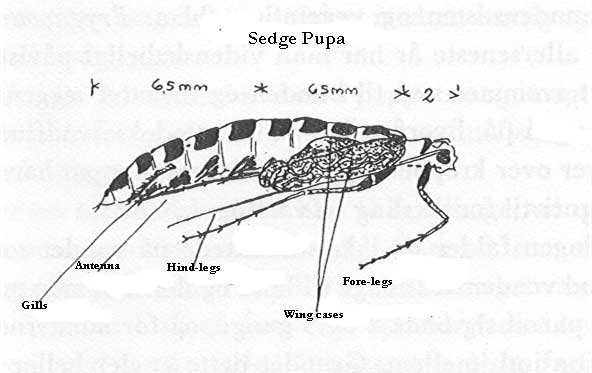
beetles, Daddy-long-legs, but it is also the fact when it concerns sedges and
dayflies. Many times it can be an advantage to cut the hackles underneath to 'lower'
the fly.
The great hotel proprieter and fly fisher Charles C. Ritz in his famous book
'Pris sur le Vif',
says that it is of utmost importance fishing for grayling that the fly moves
without any disturbances from the cast to which it is attached. Years ago a
french friend of mine fished the famous Norwegian grayling river Glomma. When he
presented his sedge-imitations down-stream and across and let thems move like 'the
hand of a watch' , the graylings 'went haywire' and took every fly he presented
for them!
In May 2000 I visited once more Austria and my host Viktor Sermek brought me in
his car to the small river Fischa, between Vienna and the Hungarian border.
Mayflies were hatching and as a result of bad legs and not fishing any longer I
was placed in a comfortable 'safari-chair' with my digital video-camera, and the
results can be seen undeneath