Simo Lumme's Sedge Pupa.
I came in 1973 into contact with the
finnish architect and flyfisher Simo Lumme.
He send me copies of some of his own creations and moreover delicate
watercolour drawings of his in Scandinavia very famous Sedge Pupa -
imitation. As his flies are very little known in Europe, I shall try to
give a description. He had in his caught trout at certain times of the
year seen a tremendous amount of sedge pupae in their stomach - and being
a draftsman he made the inspection of the stomachs the moment he had
killed them, and shortly after made sketches of them in his notebook using
an Indian ink-pen plus a few colour-pencils. One has to make this
inspection very short after the killing, then the stomach-fluids will very
fast change the colours and appearance of the insects. His tying is as
follows - he uses three different colour-variants:
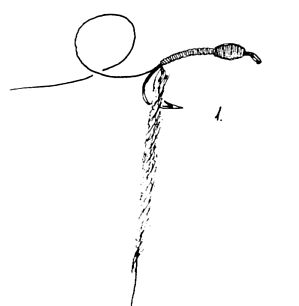
| Hook | Partridge wide gape size 12 - 10. |
| Tying silk | a. orange, b. olive and c. light brown. |
| Rib | Thin oval silver tinsel - only over the abdomen - 5-6 turns. |
| Thorax | Over a layer of thin copper-wire the tying silk is dubbed with wool from a wild rabbit - hair and fur together. |
| Abdomen | Of same colour as the tying silk. |
"I try to imitate it with a dubbing of a mixture of artificial wools - partly stiff; but with a sharp lustre like polyamid (nylon, perlon, antron etc.), partly something more soft like polyacryl (dralon, rayon or natural wool), and I use white wool to 'tone' the colours down. I cut the fibres in short lenghts, separate them and mix them thoroughly, until I get the right hue. Exactly the same way a painter mixes the colours on his palette".
Simo is not using very much dubbing - Most flytiers use all too much material! After each turn of dubbing he brushes the dubbing backwards with his fingers. In that way, the tying silk will always be close to the hook and not placed on top of another turn of dubbing. After the tying he combs the whole fly with a piece of ‘Velcro’ , so that the fibres trail backwards. Should he by accident have used too much dubbing, then he cuts the fly with a pair of scissors and then treats it once more with the 'Velcro'.
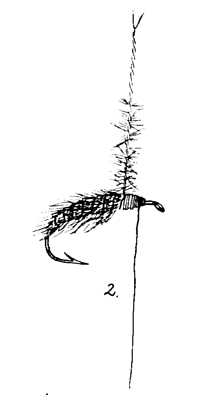
I got a large amount of the different artificial wools he used and the Antron is just as sparkling as the wool one gets today. Simo Lumme describes his final colours for the abdomen as: Light orange, light sea-green and light sandy-brown.
The tying can seem very simple; but it’s of utmost importance, that the fly looks ‘light’ and surrounded by a 'halo' of fine, fluttering fibres, that diffuse the contour of the fly.
Nalle Puh
Another of his creations is a dry sedge christened ‘Nalle Puh’ -
the finnish name for Winnie-the-Pooh.
| Hook | Partridge wide gape size 12 - 8. |
| Tying silk | Pearsall's Gossamer no. 19 - hot orange. |
| Wings | Cinnamon coloured Bear tied upright and divided. |
| Rib | Fine gold wire. |
| Body | A dubbing mixture of 50% hot orange, and 25% yellow Seal’r fur plus 25% Hare's Ear. |
| Front- and body-hackles | Natural red cock. |
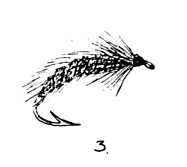
It’s a very effective fly and floats high on the water.
© Preben Torp Jacobsen. 'Flyleaves'.
Søndermarksvej 116. Hvilsom.
DK-9500 Hobro.
Denmark