Take a brush and paint a dayfly!
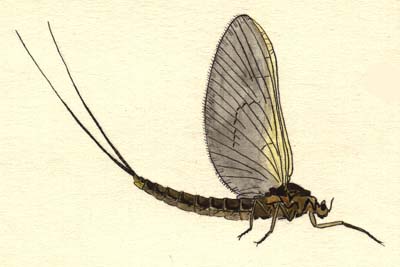
What makes fly fishing so fascinating is the fact, that
it can be associated with so many other hobbies. Someone starts even
learning to tie flies and then gets interest in fly fishing. Most of us go
the other way round - we start fly fishing and then by talks with other
fishermen get the knowledge, that one can tie ones own flies and that with
great reward.
I have tried to ‘immortalise’ them in drawings and then
afterwards give them the right colour using watercolours.
The prehistory to this is rather peculiar. I had
written my first book about dry fly-fishing and wanted to include
illustrations in colour of the different hackle-feathers and dayflies. I
made contact to one of the most ardent illustrators of scientific works we
had - Poul Winther. Unfortunately he was very sick at the moment and had
moreover a lot of work waiting from the ‘Galatea’ - deep-sea-expedition. A
good friend of mine, the late Henrik Bech, suggested that I started myself
making the drawings and afterwards put colour on. His belief in my
abilities did, that I drove to Aalborg to a paint shop, bought watercolour
paints and tools and started on my own, trying to learn the art. Even in
my time at school we had learned a little about using pencil and brush and water-colours and I had
now to renew my knowledge and even better it. In a month time I had
already made great progress and had painted the hackles, and then I
started on the dayflies (Ephemeropterae). Half a year later I had all the
drawings ready for my book. It was not so difficult as it looked on
beforehand - and in additions one learns to look at the smallest details
in their body.
The hackles were the easiest to illustrate - they ‘keep
quit’ and that even I used much time. I could of course had made them on
colour-film; but then I had
to make a lot of experiments, then their colours depends totally on the
background on which they are taken- if one wants all the finer details one
has to use the darkest photo-paper as background and that makes them very
sombre. With Indian ink and watercolours one can reproduce them in the
right structure and nuance.
Quite the opposite when we shall draw dayflies and
other insects - they are always moving around or they take a position that
makes it difficult to illustrate them. Many times like in nature they
want to sit upside/down. With some patience I succeeded - and one shall
really have good time and use much time; but then the results will be a
fine reward.
Why not also ‘immortalise’ them on film, as many ardent
photographers do? Even with the best equipment and films one can’t get the
same results as with pen and brush. With these we can illustrate the
finest details and moreover we can illustrate them with the light coming
from behind and front. I know for sure, that the only things we need are
an impression of the overall colour of breast (thorax), body (abdomen) and
wings - we shall not like e.g.. F.M. Halford try to copy every detail on
our hooks. But when we shall make a drawing and afterwards put colour on,
why not make it as exact as possible [As Francis Francis once said “If a
thing is worth doing - it’s worth doing it well”]. When we afterwards look
at the pictures we can make our own conclusions in what way we shall
imitate them! My Finish friend, the architect, the late Simo Lumme, used crayons in the
three main-colours and on a rough sketch of the fly he placed the colours
of the main-parts and by this got a moment-picture of the fly that
afterwards could be used as a fine guide, when he sat and created his
artificial flies.
Many of the colour-pictures of insects and flies in
angling books are reproduced in a too small scale - many of them nearly
useless. When we shall make our drawings and afterwards reproduce them, it
shall be in a scale from 5-10x.
At the start I bought a colour-box (Winsor &
Newton) with half-pans and at start a few colours, but as usual I supplied
and ended with these:
Cobalt Yellow - Cadmium Red - Burnt Sienna - Cobalt
blue - Emerald Green - Ivory Black - Chinese White - Raw Sienna - Venetian
red - Burnt Umbra - Davy’s Grey.
Of brushes I bought the finest round Sable brushes -
sizes 0,1,2 and one bigger for larger surfaces - they are expensive but
their money worth. The smallest are working with such a fine point that
one can use them as if they were an ink -pen. Then one needs a few
containers of glass or plastic in which to mix water and colour. The water
shall be distilled or boiled and one keeps it in a small
plastic-bottle.
I tried also to use real watercolour paper for my
drawings of hackles and insects; but I found that good, smooth drawing
One moisten the brush and makes a few strokes over the
surface of the colour-tablet in the pan and then turns the brush in a few
drops of water in the little cup and repeat the process until the colour
is right! Then one ‘paints’ a small quadrate and sign it with the name of
the colour and by this one creates a sort of colour-catalogue for
reference.
For ‘larger surfaces’ - e.g. the wings of the dayflies,
one needs one of the bigger brushes; but don’t use too much water, so that
it runs - the paper will bulge and it takes a longer time to dry. I have
always used as little water as possible and by this it is easier to
control. The same is the case when it comes to the finer details - I have
only dissolved the colour in very little water and only so little on the
fine brush that I could use it as an ink -pen and make fine lines and
dots. By this they dry very fast and one can add other colours without the
risk that they shall run into
one another.
The main rule is to start with a ‘weak solution’ - one
can always make it darker. The opposite way is much more difficult.
The best way to learn it is to start - a small box with
colour-pans, a few brushes, a water-bottle and a piece of alufolie (from
which to make cups) and a good pencil and paper fill up very little in
ones fishing bag - and are the trout or grayling dull and the weather is
good, then there is nothing more beautiful than to try make a smalldrawing and later colour it.
Good
luck!