Tup's Indispensable.
Now again one of ‘The crazy vet's oddities? Yes!
The above name is related to one of the most famous flies – to my knowledge.
As it says – it has something to do with a thing without which a ram is not
any longer a ram – and this thing is placed between its hind legs. It’s the
wool from the scrotum, which makes a vital part of the ingredients of the
dubbing for the fly.
The fly is created by a british tobacconist, who beside
his work in the shop also tied flies ordered by customers – his name was
R.S. Austin, who lived in the town Tiverton, and created the fly around year
1900. The original pattern was guarded as a business-secret until around 1940,
when Austin’s daughter Agnes, who tied the original fly after her father had
stopped, informed one of the two persons who from the beginning had got the
original recipe , the famous G.E.M. Skues permission to publish it. It was
also he who named it. The other one was the nearly as famous amateur
flydresser C.A. Hassam.
The pattern is:
|
Hook |
#16 Pennell-sneck. |
|
Tying-silk |
Yellow. |
|
Hackle |
Blue hackle of a lighter colour and freckled thickly with gold. |
|
Tails |
Fibres from a Honey Dun or light Blue Dun spade-feather. |
|
Tip |
A few turns of yellow silk – Austin pointed out that it should not be
so |
|
Body |
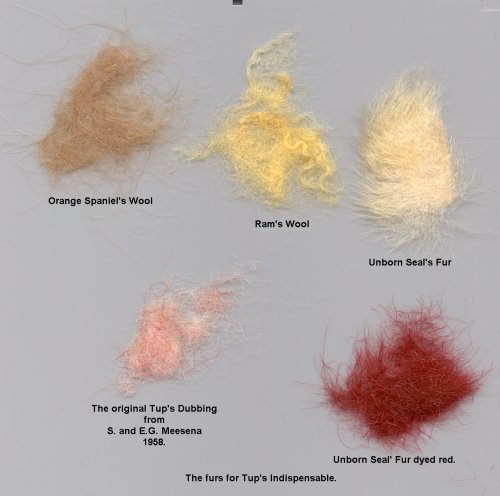
A dubbing mixture with a very faint light red colour consisting of wool from the scrotum of a ram, crème-coloured unborn seal’s fur and the same dyed red as well as yellow and a little wool from a lemon-coloured Cocker Spaniel. |
I got myself a small amount of the original dubbing in
1958 from the old English firm – S. & E.G. Messeena, and in a letter
with the parcel they informed me of the concoction and moreover added:” We are
the only people that really make up the Tup’s recipe…It’s a lot of
trouble to do” – and I can myself confirm that!. I split their dubbing and
found out exactly what a mixture it was.
Solely to get the notorious wool was a great problem – as a vet I couldn’t resist, when I visited a farmer who had sheep to ask if he also had an old ram. A lot of rams were captured, turned upside down to inspect the vital region – the reason for my nickname ‘The crazy Vet.’ – but none had the right texture and colour.
The wool shall be of a light reddish-yellow colour –
the yellow has its origin from contact with urine and the red from the faeces
from sheep bugs – moreover the wool at the named place is ‘glued’
together by fat.
At the end I got the right stuff … One day a fishing friend of mine who worked at a nearby slaughter-house came and delivered a plastic bag telling my unsuspecting wife, that it was a pouch without money!
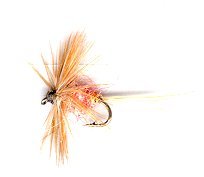
The late Molly Sweet tied the illustrated fly in 1965. As a prof she had to use inexpensive hackles, therefore she used only the very tips of the feathers and compensated using four: Two of ginger colour, one of cream and one blue dun!
. She took over the shop in Usk after the famous Welsh fly dresser and haircutter, Harry Powell. In Powell’s time it was a barbershop and in the backroom he tied his flies. One day he should tie a special fly for a customer, but couldn’t find the right wool for the dubbing, when a farmer arrived for haircutting and he had his dog, a mongrel of the right colour, with him. When he had his hair cut in the shop the dog had its hair cut a little in the backroom?
Molly's husband, Lionel Sweet, was a very famous salmon fisher and fly caster. Behind the shop he showed me how to cast a fly. He was a short, broad person with a lot of welsh humour. Many people who shall instruct in flycasting use technical terms like power fase etc. Lionel did it his own way: "When you shall throw the line and fly to the rear think that behind you is your favourite pear tree and high up in it sits a naughty boy and steals your fruits - you shall not point at him with your rod; but give him a spanking with the tip of your rod. Then you get a fast and high cast to the rear. And when you after a pause shall make the forward throw imagine that you have in front of you an oblique table full of flies and you shall not point at them with your rod; but smash them". This is a much more spectacular way to demonstrate it than the often used comparison with a hammer and a nail.